Horse Boost Official Website › Blog › Three Grams Of Sugar
Three Grams Of Sugar A Day: How To Read A Gummy’s Nutrition Block
Most supplement buyers read the ingredient list and skip the nutrition block above it. On a gummy that is the wrong way round, because the nutrition block is the part carrying the largest numbers on the label and the only part that is certainly doing something.
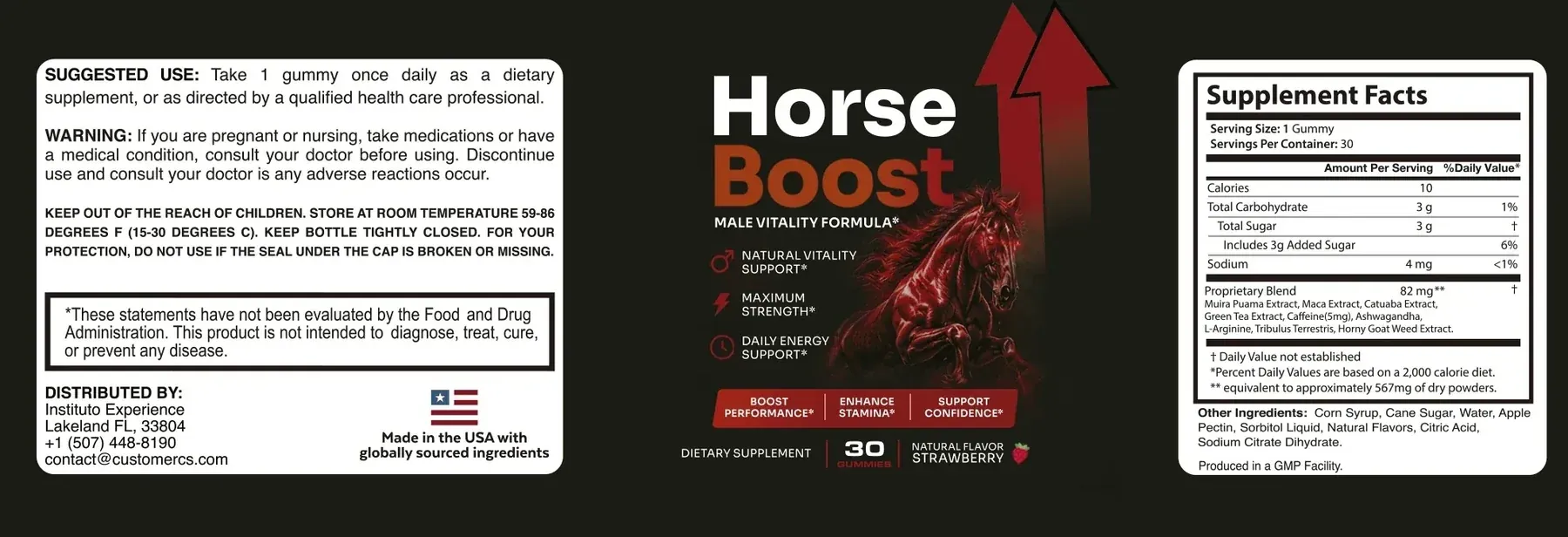
- One Horse Boost gummy carries 10 calories, 3 g of carbohydrate and 3 g of sugars.
- All 3 g are counted as added sugar, which is 6% of the Daily Value.
- Over a thirty-gummy bottle that is 90 g of added sugar.
- The botanical blend on the same label is 82 mg, about a thirty-sixth of the sugar.
- Many gummies in this category omit the nutrition block entirely. This one prints it.
Why the nutrition block is the important part of a gummy label
A capsule is a shell around a powder. Its nutrition block is usually empty because there is nothing in it to declare, and the ingredient list is the whole story.
A gummy is different in kind. It is a confection with actives suspended in it, and the confection is most of the mass. Corn syrup, cane sugar, water, pectin and sorbitol are the product by weight; the botanicals are a small addition to it. A nutrition block on a gummy is therefore not regulatory furniture, it is a description of the thing you are actually chewing.
That is the argument for reading it first. The ingredient list tells you what the product is marketed on. The nutrition block tells you what is in your mouth.
The numbers, multiplied out
| Per gummy | Per bottle of 30 | Per six-bottle run |
|---|---|---|
| 10 calories | 300 calories | 1,800 calories |
| 3 g total carbohydrate | 90 g | 540 g |
| 3 g total sugars | 90 g | 540 g |
| 3 g added sugar, 6% of the Daily Value | 90 g | 540 g |
| 4 mg sodium | 120 mg | 720 mg |
| 82 mg botanical blend | 2,460 mg | 14,760 mg |
The last row is the only one anybody buys the product for, and it is the smallest number in the table by a factor of thirty-six against the sugar on the same line.
Ninety grams of added sugar over a bottle is the figure worth carrying away. It is about eighteen level teaspoons spread across a month, or three grams a day, which is roughly two thirds of a teaspoon.
The review of free sugar and human health treats added sugar as part of a daily total wherever it arrives from, so the useful question is not whether three grams is a lot in isolation. It is whether three grams a day fits inside whatever total you are already keeping.
For most people it disappears into the noise. For anyone managing intake closely, it is a real figure with a real answer attached, and the answer is that a capsule product avoids the question entirely.
- 3 g a day is about two thirds of a level teaspoon.
- 90 g a bottle is roughly eighteen teaspoons over a month.
- 540 g across a six-bottle run, which is where the figure becomes visible.
- All of it counts as added sugar on this panel, not as naturally occurring.
- The percentage is 6% of the Daily Value per gummy, printed and correct.
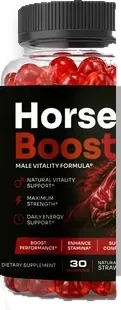
The full Horse Boost nutrition block
Every row as printed, the three percentages checked against the published Daily Values, and the Other Ingredients line in full.
Two bottles $158 · six bottles $294 · 60 days from purchase to change your mind
Order Horse Boost On The Official WebsiteOne gummy a day · 30 a bottle · lot HOR-26/HO-4117
The Other Ingredients line, read properly
Underneath the panel sits a line most readers skip, and on a gummy it is the recipe. On this one it reads: corn syrup, cane sugar, water, apple pectin, sorbitol liquid, natural flavors, citric acid, sodium citrate dihydrate.
Eight items, in descending order of weight, and every one of them earns its place.
- Corn syrup and cane sugar are the sweeteners and the bulk. Together they are the 3 g of sugars on the panel above.
- Water is the solvent the pectin gel sets out of.
- Apple pectin is the gelling agent. It is fruit-derived rather than animal-derived, which is why a vegetarian seal ships with this pack and why the word gelatin does not appear.
- Sorbitol liquid is a humectant. It keeps the gummy from drying out on a shelf, and in much larger quantities it is a laxative, which is a category fact rather than a warning about one gummy.
- Natural flavors is the strawberry named on the front panel.
- Citric acid is the acidulant, and part of what a pectin gel needs to set.
- Sodium citrate dihydrate is a buffering salt, and it is where the 4 mg of sodium on the panel comes from.
Two things are worth noticing about that list. The first is that it is complete: nothing is grouped, nothing is hidden behind a proprietary heading, and every item can be looked up. The contrast with the blend row three lines above it is stark, and it is a good illustration of how differently the two halves of a supplement label are regulated.
The second is the pectin. For a chewable product aimed at men, the default assumption is gelatin, and a buyer who wants to avoid it would otherwise have to ask. Here the answer is printed, and it is the one that makes the vegetarian seal on the pack checkable rather than decorative.
What the format buys in exchange
| Format | Sugar a day | Botanical load a day | Doses missed |
|---|---|---|---|
| This gummy | 3 g | 82 mg | Fewest, on every published account of adherence |
| A typical capsule stack | 0 g | 500 to 1,500 mg | More |
| A powder | Varies with flavouring | 1,000 mg and up | Most |
Three ways to take the same ingredient families. The gummy wins one column and loses two, which is the whole of the format argument.
Adherence is the column the gummy wins, and in this category it is not a small one. The reported response times run to three or four weeks, which means the product has to be taken daily for a month before anybody can judge it, and a dose taken is worth more than a larger dose abandoned.
What it gives up is load. Eighty-two milligrams is what a palatable gummy will carry, and a capsule stack of the same ingredient families runs ten to twenty times larger. That is not a defect in this brand, it is the ceiling of the format, and a blend declaration will not tell you how the ceiling is divided.
Quality standards for gummies are also less settled than for tablets. Work on setting them measured six brands and found hardness, chewiness, cohesiveness and moisture varying considerably, with no agreed specification across the category. That is context for every gummy rather than a finding about any one.
Three sums you can check in a minute
The nutrition block is the only part of a supplement label whose arithmetic an outsider can verify, and it is worth doing once on any product you are considering. On this panel all three come out right.
Carbohydrate
Three grams against the 275 g Daily Value is 1.09%. The panel prints 1%. Correct.
Added sugar
Three grams against the 50 g Daily Value is 6.0%. The panel prints 6%. Correct.
Sodium
Four milligrams against the 2,300 mg Daily Value is 0.17%. The panel prints less than 1%. Correct.
Three small sums and all three right. That is a low bar and it is a real one: a panel that gets its easy arithmetic wrong is a panel to be careful with on the parts nobody can check. The calories row rounds, at 12 calories of carbohydrate printed as 10, which is within the ordinary rounding rules and is the kind of difference to expect rather than query.
How to decide whether it matters to you
- Multiply the added sugar by the servings per container. Write down the bottle figure.
- Multiply again by the number of bottles you are considering buying.
- Compare that against whatever daily total you keep, if you keep one.
- If you do not keep one, the question is probably answered.
- If you do, and the answer is no, look for the same ingredient families in a capsule.
If added sugar is something you actively manage, the right advice is to buy a capsule product instead of this one. That is a straight recommendation against the thing this desk sells, and it is the honest answer to a question the label itself raises by printing the figure.
What makes this panel worth reading rather than worth avoiding is that the figure is there at all. A surprising number of gummies in this category print no nutrition block and leave a buyer to infer the sugar from the ingredient list. NCCIH's guidance on using supplements wisely makes the general version of the point: a label that discloses more is a label you can make a decision with.
References
- Gillespie KM, Kemps E, White MJ, et al. The Impact of Free Sugar on Human Health-A Narrative Review. Nutrients. 2023;15(4). PMID 36839247. https://pubmed.ncbi.nlm.nih.gov/36839247/
- Adeleke OA, Abedin S. Characterization of Prototype Gummy Formulations Provides Insight into Setting Quality Standards. AAPS PharmSciTech. 2024;25(6):155. PMID 38960983. https://pubmed.ncbi.nlm.nih.gov/38960983/
- Saldanha LG, Dwyer JT, Hardy CJ, et al. Perspectives on the Use of Proprietary Blends in Dietary Supplements. J Nutr. 2023;153(5):1305-1308. PMID 37004873. https://pubmed.ncbi.nlm.nih.gov/37004873/
- Using Dietary Supplements Wisely. National Center for Complementary and Integrative Health, National Institutes of Health. https://www.nccih.nih.gov/health/using-dietary-supplements-wisely
Order Horse Boost with the block read
Ten calories, three grams of sugar, 82 mg of blend and 60 days from the day you pay to decide whether the trade suits you.
Two bottles $158 · six bottles $294 · 60 days from purchase to change your mind
Order Horse Boost On The Official WebsiteOne gummy a day · 30 a bottle · lot HOR-26/HO-4117